

Directional Derivatives and Gradient Vector
Contents
Directional Derivatives and Gradient Vector#
Gradient Vector#
For a differentiable function \(f(x, y)\), the gradient vector is defined by
Directional Derivative#
The directional derivative of \(f(x, y)\) at \((a, b)\) in the direction of a unit vector \(\hat{\boldsymbol{u}}=\left\langle u_{1}, u_{2}\right\rangle\) is, provided the limit exists,

Hence the directional derivative of a differentiable function \(f(x, y)\) at \((a, b)\) in the direction of a unit vector \(\hat{\boldsymbol{u}}=\left\langle u_{1}, u_{2}\right\rangle\) is
It is the rate of change of \(z\) in the direction of \(\hat{\boldsymbol{u}}\) (and is a scalar)
Alternative notations: \(\left.D_{\vec{u}} f\right|_{(a, b)}, \quad f_{\vec{u}}(a, b)\)
Geometrical properties#
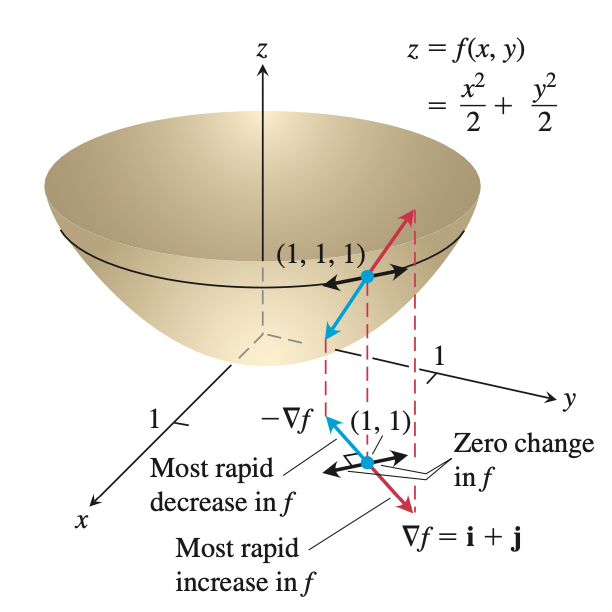
If \(f\) is a differentiable function at the point \((a, b)\) and \(\vec{\nabla} f(a, b) \neq \overrightarrow{\mathbf{0}}\), then:
\(\vec{\nabla} f(a, b)\) is perpendicular to the level curve (contour) of \(f\) through \((a, b)\)
the maximum rate of change of \(f\) at \((a, b)\) is \(|\vec{\nabla} f|\) and occurs in the direction of \(\vec{\nabla} f(a, b)\).
Functions of 3 Variables#
Similarly for a function \(f(x, y, z)\), the gradient vector is defined by
The directional derivative of \(f(x, y, z)\) at \((a, b, c)\) in the direction of a unit vector \(\hat{\boldsymbol{u}}=\) \(\left\langle u_{1}, u_{2}, u_{3}\right\rangle\) is
If \(\overrightarrow{\boldsymbol{\nabla}} f(a, b, c) \neq \overrightarrow{\mathbf{0}}\), then:
\(\vec{\nabla} f(a, b, c)\) is perpendicular to the level surface of \(f\) at \((a, b, c)\)
the maximum rate of change of \(f\) at \((a, b, c)\) is \(|\vec{\nabla} f|\) and occurs in the direction of \(\vec{\nabla} f(a, b, c)\).
Algebraic Rules of Gradient#


